Vulcão glaciar Eyjafjallajökull
créditos: Ivo Bessa Martins

Vulcão Eyjafjallajökull
Um geólogo islandês afirmou hoje, sábado, que a actividade do vulcão em erupção no glaciar Eyjafjallajökull se intensificou, criando uma nuvem de cinzas que alcançará cerca de 8,5 quilómetros.
Magnus Tumi Gudmundsson, geólogo da Universidade da Islândia, disse que o vento melhorou a visibilidade e que hoje, sábado, será o primeiro dia em que os cientistas conseguirão sobrevoar o vulcão.
Enquanto os cientistas determinam a quantidade de gelo que foi derretida, dado que o vulcão se encontra num glaciar, será mais fácil determinar quanto tempo durará a erupção.
O geólogo islandês considera que enquanto houver gelo suficiente, mais nuvens se formarão, podendo causar ainda mais impactos no espaço aéreo europeu.

credits : REUTERS
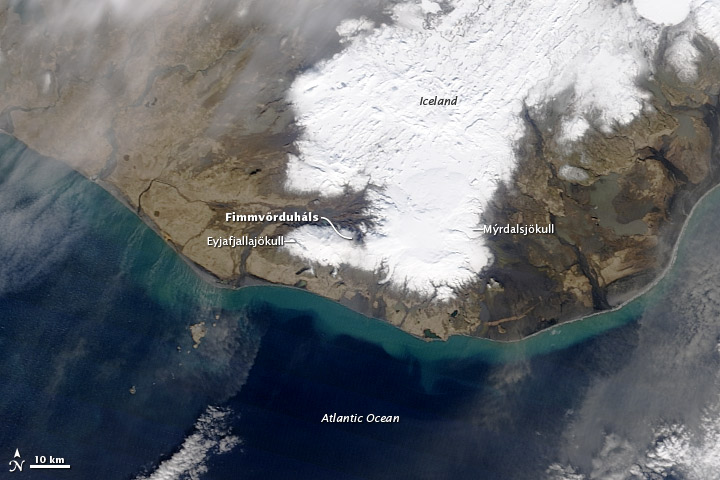
Eyjafjallajökull, a volcano on the Eastern Volcanic Zone in southern Iceland, began to erupt on 14 April 2010.
A plume of volcanic ash was at times ejected several kilometers into the atmosphere by this eruption, potentially causing a hazard for aeroplanes.
All flights in several European countries have been suspended as ash from a volcanic eruption in Iceland moves south.
Up to 4,000 flights are being cancelled with airspace closed in Norway, Sweden, Finland and Denmark among others.
Occasional disruption continued when increased explosive activity at the volcano coincided with northerly to north-westerly winds that brought the ash towards Europe.

credits : NASA
The Health Protection Agency said the ash from the Eyjafjallajökull eruption did not pose a significant risk to public health because of its high altitude.
Initial reports suggest glacial melt from Iceland's Eyjafjallajökull volcano, located about 75 miles (120 kilometers) from Reykjavik, has raised local rivers by as much as ten feet (three meters).

Eyjafjallajökull volcano, Iceland
AP Photo/Reynir Petursson, Helicopter.is
On Sunday 18 April researchers from the University of Iceland estimated that about 750 tones of magma were ejected from the volcano every second.
By 20 April, most of the ice in the crater appeared to have melted, the plume was only reaching heights of up to 4 km (13 100 feet), and the amount of material being ejected into the plume had increased significantly.
As the amount of ice available to interact with the magma decreased, the volcano changed from producing ash to mainly producing fire fountains.

Eyjafjallajökull volcano. Iceland
Photo of the Day
credits: Sigurdur Hrafn Stefnisson
A film crew working for National Geographic publication set-up on southern Iceland's Eyjafjallajökull glacier after landing on the glacier, close to the volcanic eruption, on Sunday April 18, 2010.
Scientists say that because the volcano is situated below the glacial ice cap, magma is being cooled quickly, causing explosions and plumes of grit. The eruption is ongoing and forecasters have predicted that light prevailing winds in Europe mean that the situation for air travel is unlikely to change in the coming days.
Let's see a video showing ITN reporter John Irvine taking a helicopter flight above the crater of the Icelandic volcano that has grounded European flights with its continued eruption of ash into the skies above northern Europe.
Geração 'explorer'
17.04.2010

References : British Geological Survey