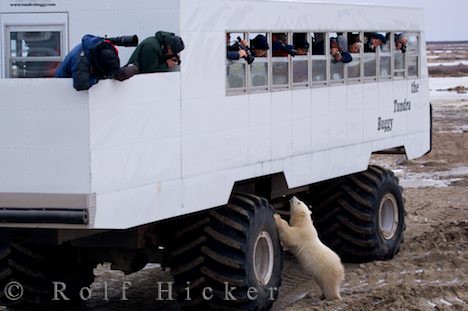
Polar bears, Churchill, Canada
http://www.everythingchurchill.com/
Descobrimos hoje este vídeo sobre o urso polar na capital mundial do urso polar, Canadá.
Dado que o consideramos muito elucidativo dos perigos de juntar turismo com animais selvagens, decidimos partilhar.
O Canadá é o país de 15,000 ursos polares aproximadamente que sobrevivem em condições particulares.


E a questão que surge é pode o turismo ajudar os esforços de conservação, quando se trata de espécies ameaçadas?
Brandy Yanchyk faz uma reportagem de Churchill, Manitoba onde durante dois meses por ano, os ursos polares são mais numerosos que os habitantes?
bears outnumber residents.
Poderá ler outros posts dedicados ao urso polar neste blog. Por exemplo o Dia Internacional do Urso Polar ; O urso polar pode ser salvo? ; The Daily Planet : Polar bears waiting for sea ice to freeze ; SOS Urso Polar ; Urso polar faz parte das espécies ameaçadas ; Urso polar inspira coca-cola ; Knut, um urso especial ; Urso Polar : Planeta Tierra ; Ursos polares espiados ; Arctique : documentaire 3D ;
The polar bear capital of the world’ is the theme of this video that we found today on BBC science.
Canada is home to around 15,000 of the world’s surviving polar bears.
But can tourism help with conservation efforts when it comes to these threatened animals?
Brandy Yanchyk reports from Churchill, Manitoba where for two months of the year polar bears outnumber residents.

Polar bear :
The polar bear's Latin name, ursus maritimus, means “sea bear.” It is the only bear that is considered a marine mammal because it depends upon the marine environment for survival. It is the largest land carnivore in North America. Its long body, neck and skull distinguish it from other types of bears.
The polar bear is adapted to life in the extremes of the Arctic. Its distinctive white coat acts as camouflage in the snow and ice and it uses this camouflage to hide from the threat of human hunters as well as in stalking and hunting seals. The thick fur has glossy guard hairs and a dense layer of underfur over a thick layer of fat beneath its skin, which helps keep it warm. The soles of the polar bear's feet have small bumps and cavities that provide suction and prevent it from slipping on the icy terrain.
As a carnivore, the polar bear has physical attributes to accommodate its diet. It has large, jagged canine teeth and grinding surfaces in its cheek teeth. It also has large, strong paws for hunting seals in holes in the ice. The claws are sharp, straight, non-retractable and brownish in colour.
Read more on Canadian Geographic
On this blog you can read about International Polar Bear Day ; Can we save the Polar Bear? ; The Daily Planet : Polar bears waiting for sea ice to freeze ; Polar Bear SOS ; L'ours polaire parmi les espèces vulnérables ; Polar bears inspire coca-cola ; Knut, a special polar bear ; Polar bears : Planeta Tierra ; Polar bear : Spy on ice ; Arctique : documentaire 3D ;
Geração 'explorer'
02.12.2014